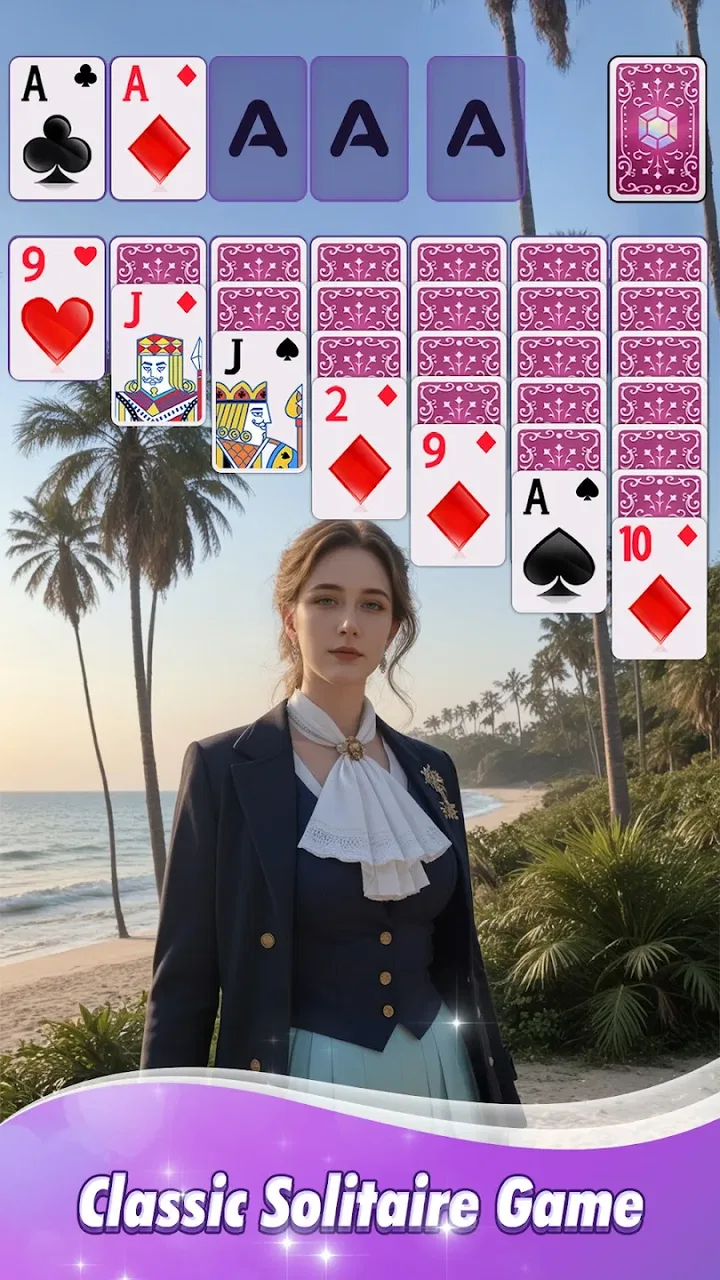
Solitaire Attraction: Card
- 4.4
- Rating
- 100.00K
- Installs
- Free
- Price

 Analysis by App-foxy
Solitaire Attraction: Card is the kind of game I open when I want a quiet break rather than a demanding challenge. It takes the familiar solitaire format and places it inside a more decorative, collection-focused presentation, giving a simple card puzzle a softer sense of progression. I found the appeal less about discovering a radically new card system and more about how comfortably a short session fits into an ordinary day.
That makes it easy to recommend to someone who already enjoys classic solitaire but wants a little more visual motivation around each hand. At the same time, I would not present it as a deep strategy game or a replacement for a serious card-game platform. Its strength is the combination of recognizable rules, a relaxed pace, and the feeling that each completed puzzle contributes to a broader visual experience.
A calm card game with a clear visual identity
My first impression was that Solitaire Attraction: Card understands the reason people return to solitaire: the rules are familiar enough to begin immediately, but every deal still asks you to make a sequence of small decisions. The game is free to start, and its Teen content rating places it comfortably in the range of casual entertainment for older children, teenagers, and adults.
You May Also Like

 Blood Strike: 2.5 Anniversary
Blood Strike’s Loadouts Turn Every Drop Into a Tactical Gamble
A close look at Blood Strike’s custom loadouts: how fast access to signature weapons reshapes its battle royale rhythm, rewards preparation, and narrows the gap between fights.

 Pandora - Music & Podcasts
Pandora’s Music Is Easy to Start, but Harder to Recover
Pandora’s strength is its low-effort path from a seed to a station. Its weak spot is how much confidence it asks you to place in connection, setup, and quiet recovery.

 8 Ball Pool
 Is Built on Rivalries, Rematches, and Routine
A close look at the rivalries, rematches, shared routines, and unanswered safety questions that turn a quick pool match into a persistent mobile community.

 Samsung Music
’s Quiet Strength Is Playing What You Already Own
Its reach comes less from spectacle than from dependable access to a personal library. That simplicity is both the app’s strongest retention engine and its ceiling.

 AccuWeather: Weather Radar
AccuWeather Review: A Quick, Clear Forecast for Everyday Decisions
For everyday plans, the best forecast is the one you can understand quickly. AccuWeather makes rain timing, radar, and local conditions easy to act on, with a few trade-offs.

 Hill Climb Racing
Why Hill Climb Racing Still Turns Crashes Into One More Run
A tiny car, a bumpy hill and one more upgrade: Hill Climb Racing keeps resurfacing because its simple chaos makes every near-miss feel personal.
More From Our News Desk
View All News


The presentation appears designed to make routine play feel more inviting. Rather than treating a completed hand as the only reward, the game connects the card-puzzle activity with collecting beauty. That framing gives the session a gentle destination. I am not simply clearing columns; I am also working toward the next visual piece of the experience.
That distinction matters during short sessions. If I have only a few minutes while waiting for an appointment or taking a break from work, I do not need to learn a new system before playing. I can begin with the familiar solitaire structure, make a few moves, and stop without feeling that I have abandoned a complicated quest. The game’s identity comes from making that routine feel more attractive.
The title is published by Moayed Alharazeen, and the current version is 1.0.10. It requires Android 6.0 or later, which makes it accessible on a broad range of older Android devices as well as newer phones. That is useful for a card game because solitaire does not need to be tied to the newest hardware to be enjoyable.
Its audience is already fairly substantial, with over one hundred thousand installs and an average rating of 4.4 from around five thousand ratings. I read those figures as a sign that the basic proposition is landing for many players, though popularity alone does not tell me whether its particular visual style will suit everyone.
Why the opening minutes work
The opening experience is strongest when I approach it as a small ritual. I can sit down, choose to play a hand, and let the familiar layout do most of the teaching. That low barrier is one of the game’s biggest advantages over more elaborate card titles, where menus, currencies, challenges, or competitive systems can distract from the actual cards.
The collection angle also gives the game a different emotional target from a plain solitaire utility. A basic alternative may be better if I only want the fastest possible deal with no decoration or surrounding motivation. Here, the extra layer is part of the reason to return. The trade-off is that anyone who prefers an entirely stripped-down interface may find the presentation less direct than a minimalist solitaire app.
I also appreciate that the game does not need a dramatic premise to justify itself. Its setting is expressed through the visual idea of beauty and collection rather than through a large narrative. That keeps the focus on the hand in front of me. The result is more like a decorative retreat than an adventure, and that is exactly where its personality begins to separate it from ordinary card utilities.
Art direction that supports the card table
The art direction is important because the underlying rules are so well known. When a game uses a classic solitaire foundation, the surrounding visual language has to provide the sense of occasion. In this case, the beauty-collecting concept gives completed play a more ornamental context, helping the game feel like a destination rather than a generic deck on a blank screen.
What works for me is the relationship between the practical and decorative parts of the experience. The cards still need to remain readable, and the surrounding presentation should not compete with the columns or waste the player’s attention. A successful solitaire design makes the next legal move easy to inspect while allowing the background and rewards to create mood. That balance is more important here than visual complexity.
I would describe the atmosphere as gentle rather than intense. There is no obvious need for the game to push urgency into every hand. Solitaire already creates its own tension through limited spaces and the risk of blocking a useful card, so a calmer visual treatment lets that small tension breathe instead of turning it into pressure.
The collection theme can also change how I judge a loss. In a purely functional solitaire app, an unsuccessful deal is simply a failed attempt. In a more decorative game, the completed hands feel connected to gradual visual progress. That does not transform the rules, but it gives the repetition a stronger emotional reason. The best way to use this is to treat the collection layer as encouragement, not as a promise that every hand will be winnable.
Sound and pacing during everyday play
Sound is a subtle part of a card game’s mood. Solitaire does not need an aggressive soundtrack or constant alerts; those would work against the reason many people choose it. I found that the game’s overall concept is best suited to restrained audio and clear feedback, where card movement and completion feel satisfying without interrupting concentration.
That makes it a natural fit for a quiet evening, a short commute when I am not driving, or a pause between tasks. I can play one hand as a mental reset rather than committing to a long session. The pacing is shaped by the player’s decisions, not by a countdown or a forced action sequence, so I can think through a move without feeling chased.
There is a useful difference between slow pacing and empty pacing. A solitaire game can feel slow if every action is buried under unnecessary transitions. It feels calm when the interface gives the player time while still responding promptly. The collection theme benefits from the second approach: visual rewards should make completion feel pleasant, but they should not turn every hand into a long interruption.
For my own routine, the most practical method is to use it as a boundary between activities. I might play one deal after finishing a work block, then stop before the session expands into aimless scrolling. Because the game is free to download, it is easy to try this habit without making a financial commitment. The important point is to keep the game in the role of a short reset if that is what I want from it.
How the familiar mechanics fit the mood
The central appeal remains the card puzzle. Solitaire rewards planning several moves ahead, keeping open spaces useful, and resisting the temptation to make the first available move automatically. Those decisions are small, but they create the satisfying rhythm that has kept the format popular for so long.
Solitaire Attraction: Card fits that rhythm because its surrounding presentation does not require the player to abandon the classic mental process. I can focus on uncovering hidden cards, arranging sequences, and deciding when to move a card to a foundation. The decorative layer adds motivation without changing the basic reason the game works.
One practical tip is to treat the collection goal as a reason to play carefully, not quickly. When I rush through a familiar layout, I am more likely to close off a column or use a valuable empty space too early. The atmosphere may be relaxed, but the strongest play still comes from pausing before each irreversible-looking move and checking whether another card could reveal more information.
A second useful habit is to separate “progress” from “winning every time.” Classic solitaire contains uncertainty, and not every deal will reward the same approach. If I judge the game only by uninterrupted success, the decorative presentation cannot prevent frustration. If I instead use each hand as a short puzzle and let the collection theme provide a broader sense of movement, the experience feels more sustainable.
A third trade-off concerns attention. The visual rewards can make repeated play feel more purposeful than a bare-bones solitaire app, but they may also encourage me to continue after the relaxing part of the session has ended. I would set a personal stopping point, especially if I am playing late at night. The game is most effective when its attractive presentation supports a break rather than quietly turning that break into a long routine.
Free access and the purchase question
The game is free, with optional in-app purchases ranging from $0.99 to $199.99 per item. That wide range is worth noticing before spending anything. I can try the core experience without paying, but players who are sensitive to optional purchase prompts should decide in advance whether they want to ignore them or set a firm budget.
For me, the sensible approach would be to evaluate the unpurchased experience first. A solitaire game should earn its place through the quality of its card play and atmosphere before I consider buying anything connected with collection or convenience. If the basic loop already gives me satisfying short sessions, I may not need to add spending to make it worthwhile.
This is also where a different alternative may be better. Someone seeking a completely distraction-free card tool, with no interest in decorative progression or optional purchases, may prefer a minimalist solitaire game. Someone who wants competitive rankings, multiplayer matches, or a large range of named variants should look toward a broader card platform instead. Solitaire Attraction: Card is more focused: its appeal comes from a familiar puzzle wrapped in a beauty-oriented mood.
Who will enjoy it most
I think the best match is a player who already understands solitaire or wants a gentle introduction to the format without a heavy learning curve. It suits people who enjoy collecting visual rewards, appreciate a calm setting, and prefer sessions that can end after a single hand. It can also work well for older Android phones because the minimum operating-system requirement is Android 6.0.
It is less suitable for someone who needs constant novelty. The familiar mechanics are the point, so players who quickly tire of repeated card layouts may not find the collection concept strong enough to carry long-term interest. It is also not the right choice if I want a story-driven game, a competitive card battler, or a complex deck-building system.
The Teen rating is another practical consideration for families. Adults can decide whether the presentation and purchase options suit a younger player, but I would not assume that a casual card format automatically makes every part of the experience appropriate for every household. A quick look at the game together is sensible before handing it to a child.
Where it sits beside ordinary solitaire apps
Compared with a plain solitaire app, this game offers more of a visual reason to keep playing. The basic alternative wins on simplicity: open it, play the hand, and leave. Solitaire Attraction: Card wins when I want the same familiar structure to feel more like a themed pastime, with beauty and collection giving completion a little extra meaning.
Compared with a large card-game suite, it is narrower but easier to understand. A suite may offer multiple solitaire variants, puzzles, daily tasks, statistics, and social systems. That variety is valuable for players who need constant options. Here, the focused identity is less intimidating and better suited to someone who wants one recognizable activity presented with a consistent mood.
The most important comparison is not the number of features but the kind of attention each app asks from me. A minimalist title asks for almost nothing beyond the hand. A broad suite asks me to explore. This game asks me to settle into its visual atmosphere while making familiar decisions. That middle ground is its clearest reason to exist.
My final take on the atmosphere
After spending time with it, I see Solitaire Attraction: Card as a mood-driven solitaire game rather than a reinvention of solitaire. Its art direction gives the classic card puzzle a more inviting setting, while the collection idea adds a gentle sense of direction. The sound and pacing are most convincing when they stay subordinate to the cards, allowing the player to relax without losing the small strategic pleasure of each move.
There are limits. The familiar mechanics will not satisfy players who need deep variation, and the optional purchase range means I would approach spending carefully. The decorative layer can also become less meaningful if I am looking only for the quickest possible deal. Those are not flaws for every audience, but they define the boundaries of the experience.
My recommendation is simple: choose this game when you want solitaire with a softer, more collectible atmosphere, not when you want a full card-game playground. I would install it for short breaks, quiet evenings, and familiar puzzle sessions where presentation matters almost as much as the win. If that sounds like your kind of downtime, the free entry point makes it easy to judge for yourself. If you prefer pure efficiency or competitive depth, another solitaire option will probably serve you better.
Overall, the game succeeds by understanding that a classic card puzzle does not always need new rules to feel pleasant. Sometimes it needs a coherent setting, a comfortable rhythm, and a reason to return after the hand is over. That is the space Solitaire Attraction: Card occupies, and in my experience, it occupies it with enough personality to stand apart from a completely ordinary solitaire utility.
FAQs for Solitaire Attraction: Card
01What features does Solitaire Attraction: Card offer?
Solitaire Attraction: Card offers a modern twist on the classic solitaire game. It includes daily challenges, multiple themes, and customizable card designs. The app also provides hints and undo options to help you strategize better. With smooth animations and an intuitive interface, it ensures an engaging user experience.
02Is Solitaire Attraction: Card available offline?
Yes, Solitaire Attraction: Card can be played offline. This makes it perfect for users who want to enjoy the game without needing an internet connection. You can play anywhere, whether you're commuting or in a location with limited connectivity, ensuring entertainment on the go.
03Are there in-app purchases in Solitaire Attraction: Card?
Solitaire Attraction: Card offers in-app purchases. While the game is free to download, users have the option to purchase additional themes and power-ups. These purchases enhance gameplay but are not necessary for enjoying the basic features of the game. Players can still have a full experience without spending money.
04How does Solitaire Attraction: Card handle user data privacy?
The app prioritizes data privacy by adhering to industry standards. It only collects necessary information to enhance gameplay and user experience. Users can review the privacy policy within the app to understand how their data is managed and protected, ensuring transparency and trustworthiness.
05What devices are compatible with Solitaire Attraction: Card?
Solitaire Attraction: Card is compatible with a wide range of Android and iOS devices. It requires Android 5.0 or later and iOS 10.0 or later. The app is optimized for both smartphones and tablets, offering a seamless experience across different screen sizes and devices.
Pros
- Smooth and intuitive gameplay experience.
- Customizable card designs and backgrounds.
- Offline play available for uninterrupted fun.
- Daily challenges to keep players engaged.
- Minimal ads for an enjoyable gaming experience.
Cons
- Limited multiplayer options.
- Occasional lag on older devices.
- In-app purchases can be pricey.
- No landscape mode available.
- Lacks advanced strategic modes.

Solitaire Attraction: Card
Gallery